
Hagia Sophia: “Solomon, I have surpassed thee” … or had he?
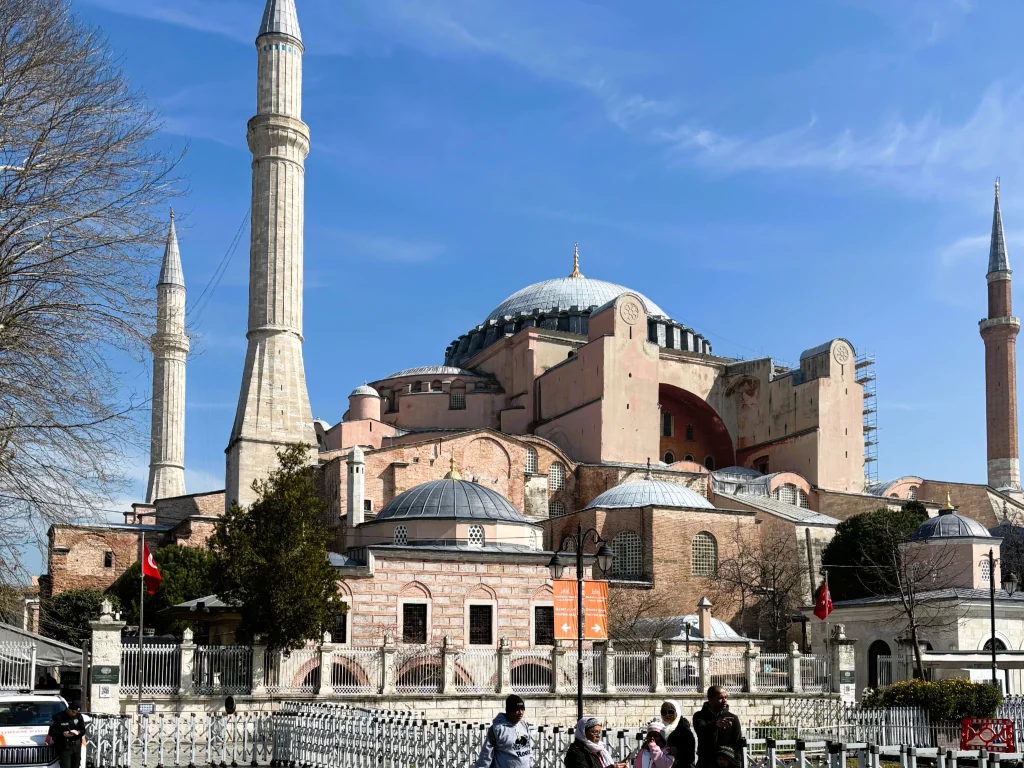
On a recent trip to Istanbul, I visited the monumental Hagia Sophia. Built in just five years (532 – 537 AD) it represents the last great flowering of Roman Architecture. The emperor Justinian famously said on its completion “Solomon, I have surpassed thee”, which perhaps he had. It became the largest church in Christendom until the 16th century and was used by reigning Roman Emperors until 29th May 1453 when Sultan Mehmed II conquered Constantinople, ending over a thousand years of emperial rule. It is incredible to think that Roman Emperors walked the earth while the English and French were fighting at Agincourt. Looking at Hagia Sophia made me wonder how those structural innovations came to Europe and why the ornament is not of the quality of Rome in its hay day.
When an architect has a compelling and original idea, one is initially tempted to see it as a work of genius. But often on closer observation, these inspired ideas come from a knowledge of examples from beyond the horizon of their audience. This can be seen in Inigo Jones’s use of Italian architectural forms which stunned the Stuart Court, or Degas’ compositions borrowed from Japanese woodcuts.

The use of pendentives is one such example, and the vast span of Hagia Sophia would not have been possible without them. The pendentive is a fascinating form. It is the reconciliation between the circular plan form of a dome with the square form of the room below. The Western Roman Empire had not worked this out. The Pantheon, for example, has a circular plan that mirrors the circular dome.

To make a square room with a round dome, the gap between the two different shapes at the corners need to be reconciled with a triangular form which rises at an angle at the top, follows the form of the circular dome and at the bottom goes to a point at the corner of the square room below. Pendentives have been built throughout the world since the Renaissance, as can be seen at St. Peter’s Rome, St. Pauls London, and the Capitol in Washington D.C.


Though Justinian had much to boast about, in some ways he had fallen behind not only Solomon but also earlier emperors who made their own columns when they wanted to build an ambitious work. The column shafts of Hagia Sophia have been looted from a variety of earlier pagan temples from all over the Empire. The capitals and all the carved ornament, though intricate in design, does not have the beauty of Roman capitals carved half a millennia before. When Justinian’s masons carved ornament, it looks clumsy and ungracious. I see this as evidence of an empire in decline.


This type of substandard carving can be seen throughout the Roman Empire. From about 300 AD onwards the incredible sculpture of Rome at the time of Augustus gave way to a stiff leaden style that afflicted the whole empire – not just Constantinople. One just has to look at the beauty of the Ara Pacis (13 – 9 BC) to see how the quality had fallen.


Had Justinian surpassed Solomon? The answer is yes and no. I would imagine in pure scale he had. But the quality of the ornament I would imagine was inferior. According to an account in the Old Testament (2 Chronicles 2:13-14), a highly skilled craftsman named Huram-Abi was sent by King Hiram of Tyre to assist Solomon, describing him as a “master in metalwork, stonework and fabrics”. The fact that he is named, means that his work was taken seriously. But we will never know the level of quality, unless a fragment of Solomonic ornament is found in a forgotten crate in a warehouse… camera rises slowly to view the vastness of the space, filled with thousands of similar wooden crates stacked high, cue music by John Williams, roll credits…


