
Giacomo Serpotta 1656 – 1732 : Palermo’s home grown Bernini
“In the room the women come and go, Talking of Michelangelo.” T.S. Elliot
Seeing great works of art in a world of global tourism has become increasingly difficult. In 1991 I was living in Rome, staying at the British School and I would frequently spend the morning at Villa Borghese sketching sculpture. It was free and relatively free from crowds. Not so today. Last time we went to Rome, I took a taxi to Villa Borghese only to discover that I could not visit for the next few days. The gallery is so well known that one now has to book weeks in advance. This is not my style, I get a sense of ennui walking around discovered places. I hate to be part of a herd, jostling for space. The experience becomes more like catching a train at rush hour than contemplating art.
So I am always on the look out for artists that no one knows about. One such sculptor is Giacomo Serpotta (1656 – 1732), a man described by Rudolf Wittkower as a “meteor in the Sicilian sky”.

Born in Palermo, Sicily, Serpotta worked his whole life on the island and probably never visited mainland Italy, although many historians feel he must have been as his work seems so heavily influenced by the Italian baroque and particularly Bernini.
He worked in stucco (lime plaster), a cheap material which he sometimes finished with a shiny surface to look like marble. Like many traditional artists he was from a family of stuccodores. He had a father, brother and son all in the same trade and they worked together, but Giacomo is seen as the most outstanding.
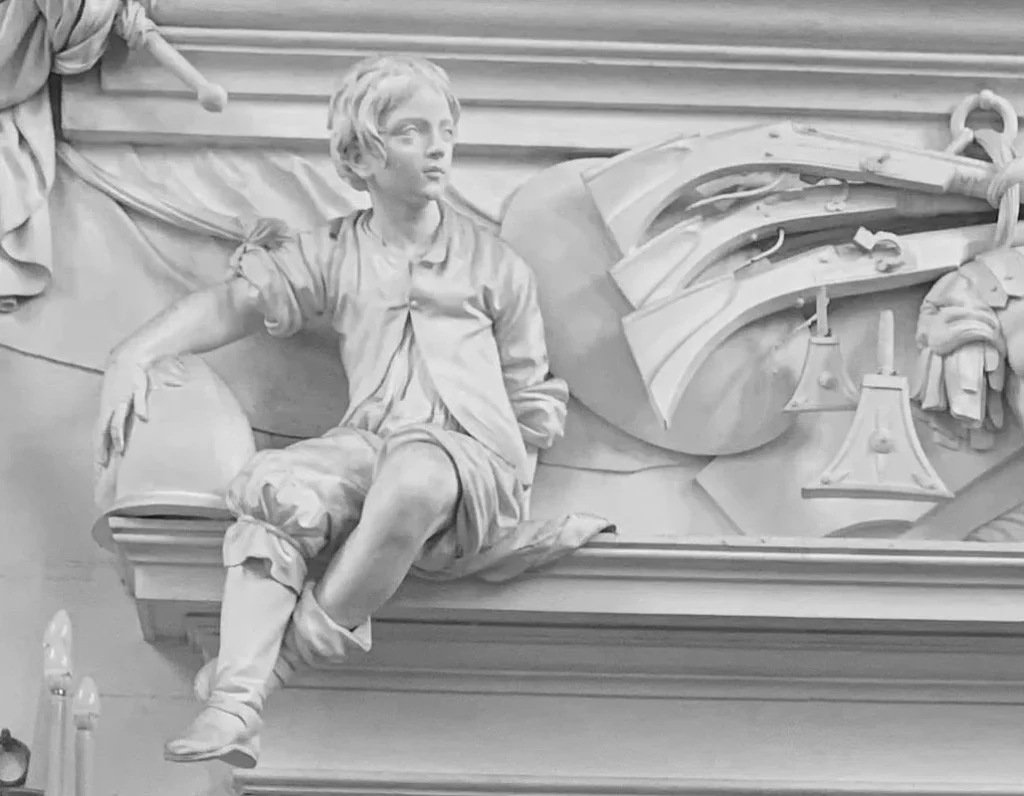
His figures are full of life and are beautiful. Their poses are natural and the figures seem to be real people. The drapery is also exquisitely rendered, not like Bernini who’s figures are framed by cloth which billows and folds like fire or cascading water, but real clothes that looks convincing and works as a foil to the figure beneath, partly revealing, partly hiding. One of the best places to see his work is at the Oratorio del Rosario di Santa Cita in Palermo. When I visited a few years ago with my wife and a couple of friends we were the only people there.


The reason I know about Serpotta is because during the 70’s and 80’s whenever my father needed to draw or paint a figure for his architectural compositions, he would invariably copy one of Serpotta’s muses. These appear in the trompe l’oeil scheme for his drawing room and numerous architectural designs.
Quite how my father came to know Serpotta is a mystery. He has never been to Palermo and so he would have only come across him through a well-thumbed book with its pages falling out and many of the images have the tell-tale sign of being copied due to the grids drawn on them.


The history of art is not the history of the best artist, it is the ones who fit the story and have been well marketed. Van Gogh would be completely forgotten if it was not for his sister-in-law, who relentlessly championed his work after his death. The Mona Lisa would not be so famous if it was not stolen in 1911.
Serpotta does not have a compelling narrative behind him, and he is not an obvious step on the road from baroque to rococo. But it would only take an opportunist film maker to invent a story about him and in a matter of minutes the Oratorio del Rosario di Santa Cita would be filled with tourists, selfie sticks in hand, queuing outside, and a gift shop with Serpotta T-shirts, keyrings and jigsaws. I know I am not helping by writing this blog, but lets hope Serpotta stays relatively obscure.


